Beyond the Bell: How Geneva's Volunteers of Faith Are Quietly Rewriting the Story of Local Education
Beyond the Bell: How Geneva's Volunteers of Faith Are Quietly Rewriting the Story of Local Education
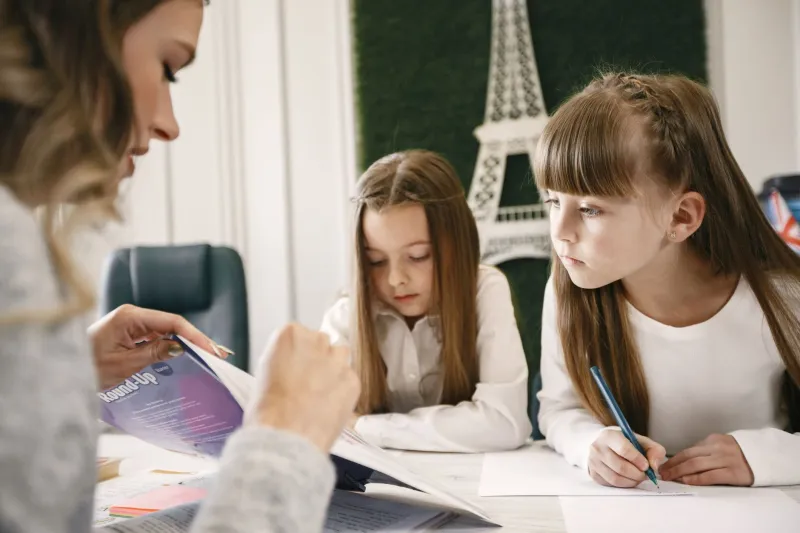
On a Tuesday afternoon in late October, a retired schoolteacher named Margaret sits across a small table from a fourth-grader named Darius, working through a particularly stubborn long-division problem. The fluorescent lights of the after-school room hum overhead. Somewhere down the hall, a basketball bounces in the gymnasium. Darius furrows his brow, erases a number, and tries again. Margaret does not rush him. She has all the time in the world — or at least, she has given him the portion of it that matters most right now.
Margaret is a longtime member of First United Methodist Church of Geneva. She is also one of more than forty volunteers from local faith communities who have quietly embedded themselves into the daily rhythms of Geneva's public schools, showing up not with an agenda or a pamphlet, but with patience, consistency, and a conviction that loving one's neighbor begins with showing up.
A Partnership Rooted in Purpose
The relationship between First UMC Geneva and the local school district did not emerge from a formal strategic plan. It grew, as so many meaningful things do, from a conversation — a school counselor mentioning to a church member that her students were struggling, that after-school hours were particularly hard, that what these children needed most was simply a caring adult who would come back next week and the week after that.
What followed was an informal but deeply intentional partnership that has since expanded to include tutoring programs, one-on-one mentorship, after-school enrichment activities, and a school supply drive that filled more than three hundred backpacks last fall. Other Geneva congregations have joined the effort, creating a coalition of faith communities united not by denomination but by a shared commitment to the children who live and learn in their city.
"We don't walk into those schools representing a religion," says Pastor Elaine Whitmore, who has helped coordinate the volunteer program at First UMC Geneva. "We walk in representing a community that cares. The faith part is the reason we go. But the work itself is for everyone."
What Consistent Presence Actually Looks Like
Ask any experienced educator what students need most, and the answer rarely begins with curriculum. It begins with relationship. Research consistently affirms what teachers have known for generations: children who feel seen and supported by a trusted adult outside their immediate family are more likely to stay engaged in school, more resilient in the face of difficulty, and more capable of imagining a future for themselves.
This is precisely what Geneva's faith-based volunteers are providing — not as a program deliverable, but as a natural outgrowth of who they are and what they believe.
Take Robert, a fifty-eight-year-old member of a Geneva congregation who volunteers as a reading mentor every Thursday morning. He works with a rotating group of second- and third-graders who are reading below grade level, spending forty-five minutes each session simply reading aloud together, talking about stories, and celebrating small victories. He has been doing this for three years. Several of his former students now stop him in the hallway just to say hello.
"That's the whole thing right there," Robert says, laughing softly. "When a kid who used to dread reading runs up to show you the chapter book they finished on their own — that's not a program outcome. That's a human being discovering something about themselves."
Families Changed on Both Sides of the Desk
The transformation these partnerships produce is not limited to students. The volunteers themselves describe something that sounds very much like spiritual renewal — a rekindling of purpose, a tangible sense that their faith is alive and active in the world.
For Margaret, the retired teacher, Tuesday afternoons have become the anchor of her week. "I was worried when I retired that I would lose my sense of usefulness," she admits. "But this has given me more meaning than I expected. These children are extraordinary. They just need someone to believe in them long enough for them to believe in themselves."
Parents, too, have noticed the difference. One mother, whose daughter has received tutoring support through the church-school program for two semesters, described the change she has witnessed at home. "She used to come home and say she hated math. Now she comes home and tells me what she figured out that day. She talks about her tutor like she's family. That matters more than I can say."
Bridging Sacred Mission and Civic Responsibility
There is a theological conviction underneath all of this that is worth naming plainly. The Methodist tradition has long held that faith without works is not merely incomplete — it is, in some essential sense, not yet fully itself. John Wesley's famous instruction to do all the good one can, in all the ways one can, for as long as one can, was never intended as an inspirational motto. It was a description of what a life oriented toward grace actually looks like in practice.
Geneva's faith communities are living out that conviction in school corridors and after-school rooms, in the patient repetition of a multiplication table and the quiet dignity of a child being told, again and again, that they are capable and worth the effort.
This model also carries a profound civic dimension. Public schools in the United States are among the last genuinely common institutions — places where children of every background, income level, and family circumstance share the same space and, ideally, the same opportunities. When faith communities choose to invest in those spaces, they are making a statement about what they value and who they believe belongs in the circle of their concern.
"There are no criteria for who we help," Pastor Whitmore says simply. "Every child in this district is our neighbor. That's not a metaphor. That's an address."
An Open Invitation
For those in Geneva who feel drawn to this kind of service but are uncertain where to begin, the answer is simpler than it might seem. First UMC Geneva coordinates volunteer placements throughout the school year and welcomes individuals from all backgrounds and walks of life. No teaching credential is required. No particular expertise is necessary. What is needed is reliability, warmth, and a willingness to show up.
The school counselor who first sparked this partnership once said that what her students needed was not a hero. They needed someone who would come back. That remains the invitation — and the discipline — at the heart of everything Geneva's faith volunteers are doing.
Darius eventually gets the long-division problem right. He looks up at Margaret with an expression caught somewhere between surprise and satisfaction. She smiles and tells him she knew he could do it. He believes her, because she has been saying it every Tuesday for four months.
That is what faithful presence looks like. And in Geneva, it is happening one Tuesday at a time.