More Than a Melody: How Geneva's Music Ministry Is Becoming a Gateway to Belonging
More Than a Melody: How Geneva's Music Ministry Is Becoming a Gateway to Belonging
There is a particular moment that happens in rehearsal — not during Sunday morning worship, not under the lights with the congregation watching — but on a Tuesday evening in a church fellowship hall, when a group of people who arrived as strangers find themselves breathing together, listening to one another, and producing something none of them could have created alone. That moment, quiet and unremarkable to the outside world, is precisely where the ministry begins.
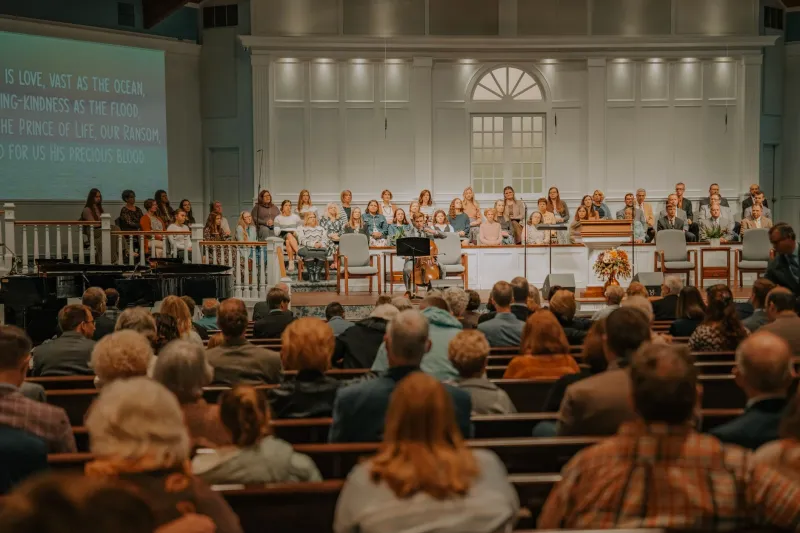
At First United Methodist Church of Geneva, music has long been woven into the fabric of congregational life. But in recent years, something has shifted. What was once understood primarily as a component of liturgy — an ordered feature of Sunday morning — has evolved into something considerably more expansive. Choir programs, contemporary worship ensembles, and intergenerational musical groups are now functioning as frontline pastoral tools, drawing in newcomers, bridging generational divides, and offering a form of emotional restoration that traditional programming alone cannot provide.
When the Choir Becomes Community
For many longtime members of Geneva's faith community, the choir loft holds decades of memory. It is a place associated with Advent cantatas, Easter anthems, and the particular comfort of familiar voices rising together in four-part harmony. But choir directors across the region will tell you that the significance of that space runs far deeper than musical tradition.
"People come to us at every conceivable point in their lives," one longtime choral director in the Geneva area observed. "Someone might join the choir after a divorce, or after losing a parent, or simply because they moved to a new city and don't know a soul. And within a few rehearsals, they have a section. They have people who notice when they're absent. That's not a small thing."
The structure of ensemble singing — the requirement that each voice serve the whole, that individual expression yield to collective sound — mirrors something essential about community itself. You cannot sing effectively in a choir while remaining emotionally isolated. The music demands presence. It demands listening. And in that demand, something therapeutic takes root.
Research in the field of music psychology has consistently supported what choir directors have observed anecdotally for generations. Singing in groups elevates oxytocin levels, reduces cortisol, and creates a form of synchronized arousal among participants that accelerates the formation of social bonds. In plainer terms: singing with other people makes you feel connected to them, and that connection has measurable effects on mental and emotional well-being.
Bridging the Generation Gap, One Rehearsal at a Time
One of the more remarkable developments within Geneva's music ministry landscape is the emergence of intentionally intergenerational musical groups. These ensembles — which might pair a sixty-year-old soprano with a seventeen-year-old violinist, or seat a retired schoolteacher alongside a college student at the piano — are doing something that the broader culture often struggles to accomplish: creating genuine relationships across age.
In a society increasingly organized by demographic cohort, where social media algorithms and age-segregated institutions keep generations largely insulated from one another, the intergenerational rehearsal room stands as a quiet act of resistance. Young people who might otherwise feel alienated by traditional worship aesthetics find themselves welcomed not as an audience, but as contributors. Older members, meanwhile, encounter the vitality and perspective of younger voices — not as a disruption, but as an enrichment.
"There's something that happens when a teenager teaches an older adult a chord progression, or when a grandmother helps a young singer find breath support," noted one worship musician involved with First UMC Geneva's programming. "The hierarchy dissolves. You're just musicians trying to serve the same song."
This dynamic has proven particularly effective in welcoming newcomers who might otherwise find the threshold of a traditional church service difficult to cross. For those who feel uncertain about theology, unfamiliar with liturgical customs, or simply shy about walking through the front doors alone on a Sunday morning, joining a musical ensemble offers an alternative point of entry — one defined by shared purpose rather than doctrinal fluency.
Contemporary Worship and the Question of Accessibility
The rise of contemporary worship music within mainline Protestant congregations has not been without its tensions. For many in the Methodist tradition, the hymnal represents a sacred inheritance — a repository of theological depth and musical craftsmanship accumulated over centuries. The introduction of projection screens and acoustic guitars has, in some congregations, generated genuine friction.
At First UMC Geneva, however, the conversation has increasingly moved away from either/or frameworks and toward something more integrative. The question being asked is not whether to sing Wesleyan hymns or contemporary praise music, but rather how each form of musical expression can serve the congregation's broader pastoral mission.
Contemporary worship bands, when thoughtfully led, offer something that traditional choral formats sometimes do not: a lower barrier to participation. A young person who has spent years playing guitar in a garage band may find the worship team a far more accessible entry point than the formal choir. And once inside that entry point — once connected to a community of fellow musicians who share a common purpose — the deeper dimensions of faith and belonging have room to develop.
"We're not asking people to choose between ancient and modern," one worship leader at a Geneva-area congregation explained. "We're asking them to show up, bring what they have, and let the music do what music has always done — which is to open people up to something larger than themselves."
The Pastoral Dimension Nobody Talks About
Perhaps the most underappreciated aspect of music ministry is what happens in the margins — before rehearsal begins, during the break, in the parking lot afterward. These are the moments when the pastoral work of music becomes most visible: the choir member who mentions a health scare and finds herself surrounded by people who will pray for her by name; the teenager who confides in a worship team mentor that things at home have been difficult; the widower who, three months after losing his spouse, quietly admits that Tuesday rehearsal has become the thing he most looks forward to each week.
Choir directors and worship leaders are, in many respects, unordained pastors — people who hold the emotional lives of their ensemble members with a care and attentiveness that extends well beyond the notes on a page. This reality is increasingly being recognized within congregational leadership circles, where music ministers are being understood not merely as program directors, but as essential members of a holistic care team.
At First UMC Geneva, this recognition shapes the way music ministry is resourced, supported, and integrated into the congregation's broader mission. The choir rehearsal is not merely preparation for Sunday. It is, in itself, an act of ministry — a weekly gathering where belonging is practiced, grief is witnessed, and joy is made audible.
A Song That Keeps Expanding
There is an old Methodist conviction, rooted in the hymn-writing legacy of Charles Wesley, that theology is best learned through song — that the truths of faith penetrate more deeply when set to melody than when delivered from a lectern. Geneva's music ministry, in its contemporary expression, is honoring that conviction in ways its founders might not have anticipated.
The congregation that gathers around a song is not simply performing a ritual. It is rehearsing a way of being together — attentive, responsive, interdependent, and open to something greater than any individual voice. In that rehearsal, week after week, something is being built that no single program or initiative could construct alone.
It sounds, if you listen closely, like community. It sounds like healing. It sounds, in the best possible sense, like church.