What the Stone Walls Already Know: How Church Architecture Is Quietly Healing the Anxious Mind
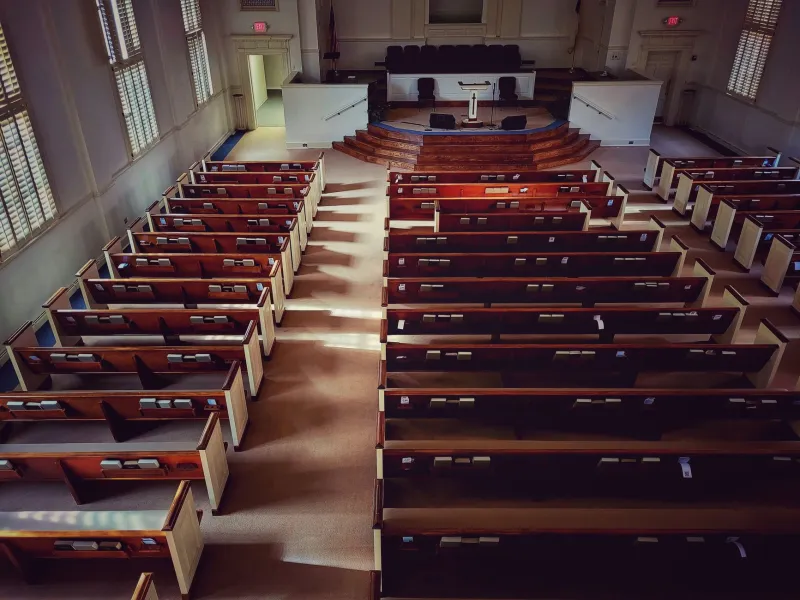
There is a particular kind of stillness that greets you the moment you step through the doors of First UMC Geneva on an ordinary Tuesday afternoon. No service is scheduled. The choir is not rehearsing. The fellowship hall is quiet. And yet a handful of people are seated in the pews — not praying aloud, not reading, not doing anything that would register as productive by the metrics of a busy week. They are simply present. And for many of them, that is precisely the point.
Across Geneva and throughout the broader American church landscape, something quietly significant is being noticed by clergy, counselors, and congregants alike: the physical space of the sanctuary itself — its proportions, its materials, its deliberate sensory architecture — appears to be providing measurable relief to people who arrive carrying burnout, grief, and a nervous system stretched well past its limits.
This is not a new phenomenon, exactly. But it is one that is receiving renewed attention at a moment when anxiety disorders affect more than forty million American adults and when the concept of psychological safety has moved decisively from clinical settings into everyday conversation.
The Body Knows Before the Mind Does
Dr. Renata Osei, a licensed therapist who works with several faith communities in the Geneva area and identifies as a practicing Christian, has spent years observing what she describes as the "sanctuary effect" in her clients.
"When someone who has been white-knuckling their way through a difficult season finally sits down in a quiet church space, their body often responds before their theology has a chance to catch up," she explains. "The high ceilings prompt a natural deepening of the breath. The dimness signals to the brain that it is permitted to stop scanning for threats. The absence of screens removes the expectation of response. These are not trivial things. These are neurobiological events."
The science behind her observation is increasingly well-documented. Research in environmental psychology has demonstrated that spaces characterized by vertical height, reduced ambient noise, natural light filtered through colored glass, and a notable absence of commercial signage tend to activate the parasympathetic nervous system — the branch responsible for rest, digestion, and emotional processing. Churches, built over centuries with an intuitive understanding of human reverence, happen to embody nearly all of these features.
At First UMC Geneva, the sanctuary's arched windows cast a particular quality of morning light that several longtime members describe in almost identical terms: soft, diffuse, unhurried. The wooden pews, worn smooth by generations of worshippers, carry a tactile quality that grounds the body in a way that a folding chair simply cannot replicate. Even the faint smell of aged wood and candle wax functions as what psychologists call an "environmental anchor" — a sensory cue that tells the nervous system it has arrived somewhere set apart from ordinary life.
When the Building Becomes the Ministry
Pastor James Whitfield, who has served Geneva's Methodist community for over a decade, has begun thinking of the building itself as a kind of pastoral presence.
"We talk a great deal about ministry as something people do — visiting the sick, feeding the hungry, sitting with the grieving," he says. "And all of that is true and essential. But I have come to believe that this building, when we keep its doors open and its lights low and its spaces available, is also doing ministry. It is holding people in a way that we as individuals sometimes cannot."
This conviction has shaped several practical decisions at First UMC Geneva in recent years. The sanctuary is now open to drop-in visitors on weekday mornings. A small prayer alcove near the entrance has been furnished with comfortable seating, soft lighting, and a simple candle station where visitors may light a taper in acknowledgment of whatever they are carrying. No explanation is required. No sign-in sheet waits by the door.
The response has been, in Pastor Whitfield's word, "humbling." People who are not members — and some who have not attended any church in years — have begun appearing quietly, staying for twenty minutes or an hour, and leaving without speaking to anyone. A few have eventually introduced themselves. Several have begun attending services. But the staff has been deliberate about resisting the impulse to convert these visits into recruitment opportunities.
"The space is not bait," Pastor Whitfield says plainly. "It is an offering. There is a difference."
Grief, Overwhelm, and the Permission to Just Be
For Margaret Calhoune, a Geneva resident who lost her husband eighteen months ago, the sanctuary became a refuge during the weeks when well-meaning condolences felt like too much and being alone felt impossible.
"I could not bear to be at home, and I could not bear to be around people who wanted to talk about how I was doing," she recalls. "Someone told me I could just come and sit here. And I did. For weeks, I came almost every morning. I did not pray, at first. I just sat. But something about being in that space — the light, the quiet, the sense that this room had held a thousand years of human sorrow before mine — made me feel less alone in a way that conversation could not."
Her experience points to something that faith-based therapists are increasingly articulating: the church sanctuary, at its best, offers what psychologists call "containment without demand." It is a space that communicates presence without requiring performance — a quality that is particularly valuable for people in acute grief, clinical depression, or the kind of low-grade exhaustion that has no dramatic name but is quietly epidemic.
Designing for the Whole Person
Some congregations are becoming more intentional about this dimension of their spaces. Across the Methodist tradition, conversations are emerging about how sanctuary design can be made more explicitly therapeutic without losing its sacred character — a balance that requires theological as well as aesthetic discernment.
At First UMC Geneva, a small facilities committee has begun reviewing the sensory environment of the building with fresh eyes: the quality of the lighting, the acoustic warmth of the space, the accessibility of quiet corners for individuals who find the main sanctuary too formal or too exposed. The goal, as one committee member put it, is to ensure that "the building keeps telling the truth that the gospel tells — that you are welcome here, exactly as you are, and that nothing is required of you in this moment except your presence."
That is, it turns out, a remarkably countercultural message. And in a season when so many Americans are running on empty, the stone walls of Geneva's oldest faith communities may be among the most radical voices in the room.