Dog-Eared and Holy: The Church Library's Unlikely Second Life
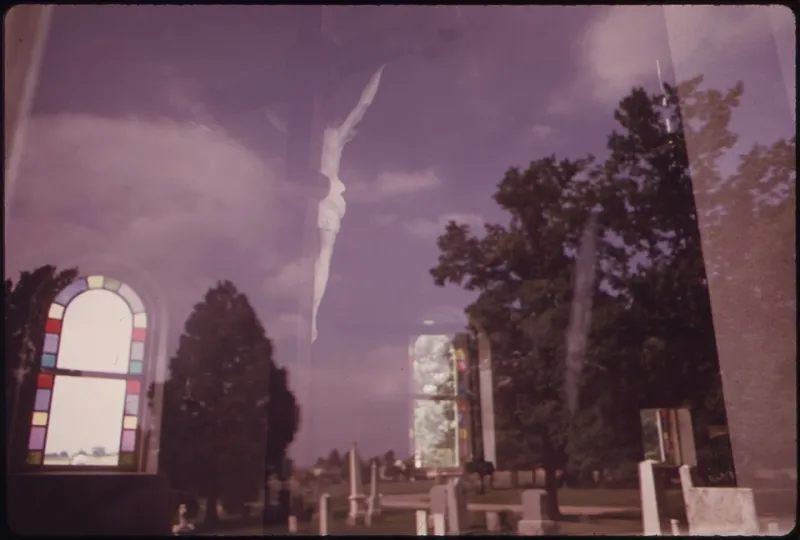
Photo: Arthur Greenberg, Public domain, via Wikimedia Commons
The room is not impressive. A converted Sunday school classroom, perhaps ten feet by fourteen, with two upholstered chairs, a lamp with a stubborn switch, and shelves that were assembled by someone whose gift was clearly not carpentry. There is no catalog computer, no barcode scanner, no budget to speak of. There is a sign-in notebook with a worn cover, and this month it has ten names in it.
Ten names is more than most of these rooms have seen in a decade. Across Geneva, the church library — that fixture of midcentury congregational life, later relegated to storage closets and memorial dedications — is quietly finding readers again.
The Room Nobody Visited
The decline is easy to trace. Sunday school classes shrank, people started reading on phones, and the library became the place where donated books went to rest in peace. Congregations inherited the complete works of Victorian preachers, novels with a saint in the title, and a shelf of cassette tapes. Volunteers aged out. The key went into the office drawer.
What revived these rooms is not nostalgia for a lost golden age. It is a changed sense of what the church offers to people who are struggling.
Curating for Doubt
The libraries that have come back to life have almost all done the same thing first: they threw things away. Not out of disrespect, but out of an honest look at whether a book was serving anybody. What survived were the books that still do something — comfort, provoke, clarify, or accompany.
Then the volunteers started buying again, carefully. Books about grief that do not flinch. Books about doubt written by people who remained in the church anyway. Books for parents who are trying to raise children in a faith they themselves are still working out. Books about prayer that are honest about what prayer feels like when it stops working. And a growing children's section on feelings, friendship, and loss, because more parents than anyone expected are using the library to answer questions they cannot answer well at bedtime.
What's on the Shelves
At the risk of turning this into a reading list — which, to be fair, is what the volunteers keep asking for — here is a small sampling of the kind of titles now circulating in Geneva's congregational libraries. These are the ones with wait lists.
- On doubt and staying: Leaving Church and Holy Envy, both by Barbara Brown Taylor, followed closely by Searching for Sunday by Rachel Held Evans.
- On grief and the limits of cliché: Everything Happens for a Reason and Other Lies I've Loved by Kate Bowler; A Grace Disguised by Jerry Sittser.
- On prayer when it will not come easily: An Altar in the World by Barbara Brown Taylor; Learning to Walk in the Dark, same author, which has been checked out for most of the year.
- On parenting and belief: Faith Unraveled by Rachel Held Evans; Raising White Kids by Jennifer Harvey, one of the most-requested titles in the parenting section.
- On the church's social conscience: The Whole Language by Gregory Boyle; Jesus and the Disinherited by Howard Thurman, a book that keeps finding new readers forty-five years after its author's death.
- For children: The Invisible String by Patrice Karst; When Sadness Is at Your Door by Eva Eland; Maybe God Is Like That Too by Jennifer Grant.
None of these are radical choices. That is the point. A library that offers only one kind of book is not a library; it is a press release.
The Volunteer Behind the Desk
Behind a table of returns at one of these churches is a retired schoolteacher who describes her Sundays now as "the best two hours of the week." She knows who is reading what. She notices when a widow checks out a second book on grief and says nothing, only sets it aside for her. She has a sign on the wall: Keep it as long as you need. Please don't feel bad about the due date. We are not that kind of library.
At another congregation, a night-shift nurse runs the library by email between shifts, sending out a three-sentence "what's new" note once a month. Circulation has nearly doubled since she started. She attributes this entirely to the fact that people now know the room exists.
Why a Book and Not a Podcast
It is worth saying plainly: a church library is not an efficient information delivery system. If the goal were content, a phone would do. What a library offers is different. A book is slow, it can be put down, and it cannot notify you. It is borrowed, which means it belongs to somebody else for a while and must be returned — a small, weekly rehearsal of the fact that our lives are not entirely our own.
A church library also tells the truth about a congregation's curiosity. Walk into the room and you can read what the community has decided is worth keeping on hand for the person who arrives next month at the worst moment of their life. That is a form of pastoral care with a spine.
How to Start — or Revive — One
If your congregation has a room full of books and nobody in it, the path back is shorter than it looks.
- Weed without sentiment. If it has not circulated in fifteen years and is not historically significant, it is furniture.
- Set an annual budget line. A few hundred dollars a year buys twelve good books and a sign.
- Leave it open. Locked libraries have a 100 percent non-circulation rate.
- Trust people. An honor-system notebook works; the fear of loss is usually larger than the loss.
- Advertise weekly. Two sentences in the bulletin, with a title and a reason to read it.
- Ask for requests. The best acquisitions come from someone saying, "Do we have anything for a parent whose teenager is depressed?"
- Keep a memory shelf. Books donated in memory of a loved one, kept in circulation rather than behind glass.
Borrowed Hope
The word library shares a root with liberty, and there is something to that. To lend a book is to say: you are free to take this, read it at your own pace, disagree with it, and bring it back. It is an act of trust extended to someone you may never meet.
In a season when many of us are looking for something to hold, a small room with a lamp and a shelf of honest books is not a modest thing at all. It is a congregation saying, in the most practical terms available, that the questions are welcome here — and that nobody has to work them out alone.