Growing Up in the Faith, Again: How Geneva Congregations Are Reimagining Adult Discipleship
There is a peculiar irony embedded in how many American churches approach the formation of their members. Enormous resources — curriculum dollars, staff hours, volunteer energy — flow toward children and youth ministry. Confirmation classes are carefully sequenced. Vacation Bible School is planned months in advance. And then, somewhere around the age of eighteen, the investment in deliberate spiritual formation tends to quietly taper off, as though the work of making disciples were essentially complete once a young person has received a Bible and shaken the pastor's hand.
The results of this assumption, accumulated over decades, are not difficult to identify. They show up in the adult who has attended church faithfully for thirty years but cannot articulate what she actually believes about grace. They appear in the middle-aged man who was raised in the faith, drifted in his twenties, returned in his forties, and finds that no one quite knows what to do with him now. They surface in the quiet epidemic of spiritual stagnation that afflicts many pews — people who are present but not growing, affiliated but not transformed.
Geneva's congregations are beginning to name this problem clearly. And some are doing something about it.
The Myth of the Finished Disciple
The theological case against spiritual complacency in adulthood is not difficult to make. The New Testament is thoroughly uninterested in the idea that formation has a finishing point. Paul's letter to the Philippians speaks of pressing on, of not having arrived. The author of Hebrews rebukes readers who should be teachers by now but still need someone to explain the basics. Jesus's call to discipleship — to follow, to learn, to be remade — carries no expiration date.
And yet the institutional logic of many congregations implicitly contradicts this theology. Sunday morning worship, however meaningful, is primarily a practice of gathering and celebration. It is not, by itself, a discipleship program. A person can attend worship every week for a decade and remain largely unchanged in their understanding of Scripture, their capacity for prayer, their ability to articulate their faith, or their formation in the practices of Christian life.
This is the discipleship gap: the distance between what congregations implicitly promise when they baptize and confirm members, and what they actually provide in terms of ongoing formation for adults.
What Forward-Thinking Congregations Are Doing
Across Geneva, a handful of congregations — First UMC Geneva among them — are experimenting with approaches to adult discipleship that take seriously both the theological imperative and the practical realities of modern life.
The practical realities matter enormously. Adults in 2024 are not short of information. They have access to more theological content, more biblical commentary, more spiritual writing than any previous generation in Christian history. What they are short of is structured relationship and accountability — the conditions under which information becomes formation.
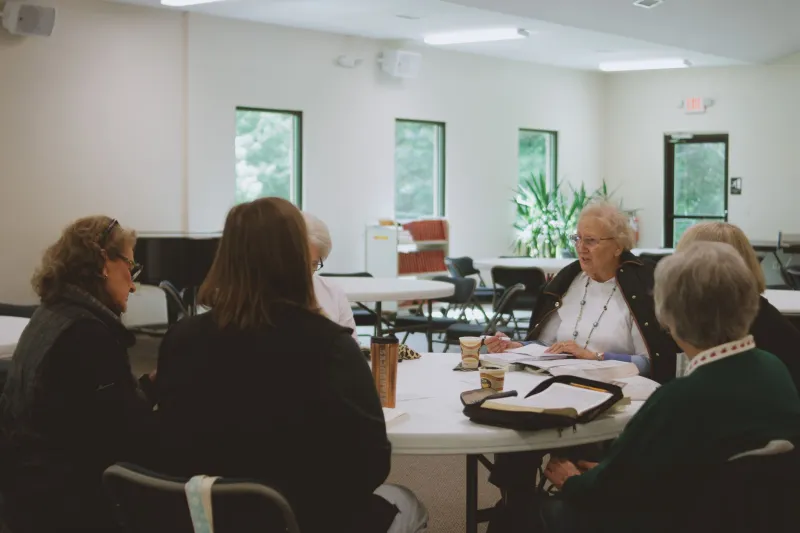
This insight is driving a shift from the traditional Sunday school model, which tends to be content-heavy and relationally thin, toward cohort-based approaches that prioritize depth over breadth. Small groups of six to twelve adults, meeting regularly in homes or church spaces, working through a shared curriculum over months rather than weeks, and holding one another accountable to practices between meetings: this model is producing the kind of sustained engagement that a single weekly class rarely achieves.
The Mentorship Dimension
Among the most promising developments in adult discipleship is the recovery of intentional mentorship — the pairing of newer or younger believers with more seasoned members for sustained, one-on-one conversation about faith and life.
This is not a new idea. It is, in fact, one of the oldest ideas in Christian formation, rooted in the apprenticeship model that characterized the early church and that was formalized in various ways across the monastic and evangelical traditions. What is new is the deliberateness with which some Geneva congregations are approaching it — identifying potential mentors, training them, making intentional matches, and providing structures that give the relationship room to develop over time.
The results, by most accounts, are quietly remarkable. Adults who have never had a sustained conversation about their faith with another believer discover, in these relationships, both permission and vocabulary to explore questions they have carried for years. Mentors, meanwhile, frequently report that the relationship deepens their own formation in ways they did not anticipate — that teaching, or simply accompanying, is itself a profoundly formative act.
Meeting Adults Where They Are
Any honest reckoning with adult discipleship must grapple with the scheduling reality. The adults most in need of deeper formation are often the ones with the least margin: parents of young children, people navigating demanding careers, caregivers for aging parents. The traditional model — a Wednesday evening class, a Saturday morning retreat — tends to reach the already-engaged and miss the people at the edges.
Forward-thinking congregations are responding with flexibility: early morning gatherings that fit before the workday begins, digital platforms that allow a formation cohort to stay connected between in-person meetings, seasonal intensives that compress deep engagement into a manageable window rather than demanding sustained weekly attendance.
The goal is not to make discipleship easier in the sense of less demanding. Genuine formation is always costly — it requires honesty, vulnerability, and the willingness to be changed. The goal is to remove the logistical barriers that prevent busy adults from accessing formation experiences at all.
A Church That Keeps Teaching
The congregation that takes adult discipleship seriously is making a particular kind of claim about what it believes. It is claiming that faith is not a childhood achievement to be preserved but a living relationship to be deepened. It is claiming that the Spirit's work of transformation does not retire at confirmation. It is claiming, in the most practical terms possible, that every adult in its pews is a disciple in process — unfinished, still becoming, worthy of the church's most careful investment.
This is not a modest claim. But it is, by the testimony of Geneva's most intentional congregations, one that is producing exactly the kind of growth — quiet, sustained, and genuinely transformative — that the church exists to cultivate.
The discipleship gap is real. But it is not permanent. And in Geneva, the work of closing it has already begun.