Wednesday Mornings and Why They Matter More Than You Think
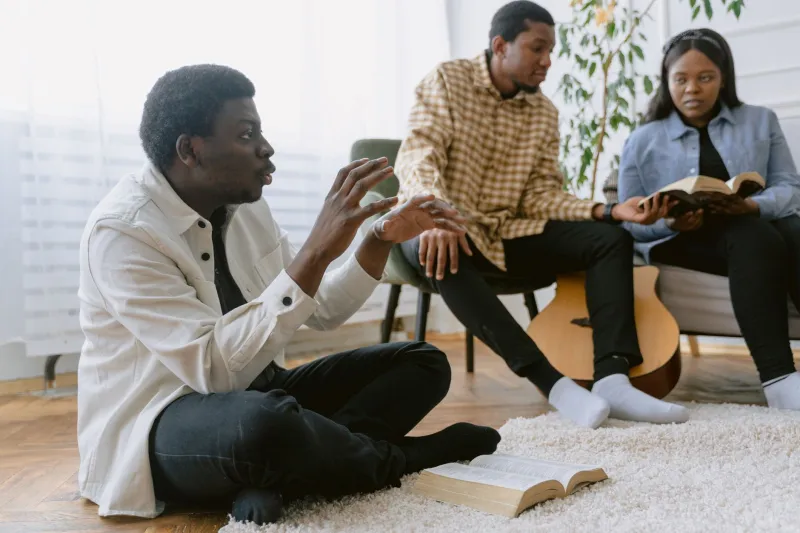
There is a living room on the north side of Geneva where seven people have been meeting every Wednesday morning for eleven years. The coffee is always on before anyone arrives. The chairs are mismatched. Someone almost always brings something baked. And every single week, without fail, at least one person says some version of the same thing: I didn't realize how much I needed this until I got here.
This is not an unusual confession. Across Geneva's faith communities — and particularly at First United Methodist Church — small-group Bible studies have become something that no curriculum designer quite planned for. They were conceived as spaces for theological exploration, for careful reading of scripture, for communal discernment. And they are all of those things. But they have also become, quietly and without announcement, some of the most significant mental health and relational support structures that modern church life has to offer.
From Scripture to Something Deeper
The evolution tends to happen gradually. A group forms around a study guide — perhaps a six-week series on the Gospel of Mark, or a seasonal Advent devotional. Participants arrive with their highlighted Bibles and good intentions. But somewhere around week three, something shifts. A member mentions that she has not slept well in months. Another admits that his marriage is under strain. Someone else — the quietest one in the room — finally speaks, and what comes out has nothing to do with the assigned passage and everything to do with why she almost did not come back after her mother died.
The scripture does not disappear. If anything, it deepens. But the group discovers that the text has become a kind of permission slip — an invitation to bring the full, unedited weight of a human life into the room and set it down among people who will not flinch.
"We started studying Paul's letters," said one longtime participant at First UMC Geneva who asked to be identified only by her first name, Carol. "And we're still studying Paul, eleven years later. But we're also studying each other. And I think that's exactly what Paul would have wanted."
The Accountability Nobody Advertised
One of the most underappreciated gifts of the weekly small group is the simple, relentless fact of its recurrence. Unlike a Sunday service — which is communal but often anonymous — a small group meets in a context where absence is noticed. Where it is remarked upon. Where someone will text you if you do not show up and mean it when they ask if you are all right.
For members who live alone, or who are navigating the particular isolation that can accompany retirement, chronic illness, or the departure of grown children from the home, this accountability is not a small thing. It is, for some, the organizing principle of an entire week.
"Wednesday gives me a reason to get up, get dressed, and leave the house," said one retired schoolteacher who has attended the same study group for seven years. "That sounds like a low bar. But when you're seventy-three and living alone, it's not a low bar at all. It's the bar."
The progressive faith tradition to which First UMC Geneva belongs has long emphasized the dignity of the whole person — body, mind, and spirit — and the recognition that spiritual health and emotional health are not separable concerns. In this sense, small groups that hold space for grief, anxiety, loneliness, and doubt are not deviating from the mission of the church. They are living it.
The Unscripted Moments Are the Point
Church program directors sometimes wrestle with how to measure the value of small groups. Attendance numbers are trackable. Curriculum completion rates can be logged. But the moment when a group member breaks down in tears and three other people move their chairs closer — that does not appear on any report.
And yet those moments are, by the testimony of nearly everyone who participates in them, the reason people keep coming back.
"Our group went off-script permanently sometime around 2018," laughed one member who co-facilitates a Wednesday evening group that began as a structured study and has since become, in his words, "more of a sacred conversation that happens to include scripture." "We still open the Bible. We still pray. But we also talk about what's actually happening in our lives. And I think God is in that conversation just as much as in the text."
This is the theological claim that progressive Methodist communities are increasingly willing to make explicitly: that the Holy Spirit is not confined to formal liturgy or prepared lesson plans. That grace moves through the unguarded confession, the shared meal, the moment when someone names their fear and the room responds not with advice but with presence.
When the Book Club Saves the Day
Several of Geneva's small groups have expanded their reading lists over the years to include not only scripture and devotional texts but memoirs, novels, and works of social theology — a development that might raise an eyebrow in more theologically conservative circles but that participants describe as deeply enriching.
"We read The Book of Joy last spring," said one participant, referring to the dialogue between the Dalai Lama and Archbishop Desmond Tutu. "And it opened up conversations about suffering and gratitude that I don't think we could have reached through a traditional study alone. It met people where they were."
The willingness to be met where one is — rather than where a curriculum assumes one ought to be — may be the defining characteristic of small groups that endure. They make room for doubt. They do not require performance. They allow a person to say I don't know what I believe right now and be held in that uncertainty rather than rushed through it.
A Ministry That Needs No Spotlight
First UMC Geneva does not advertise its small groups the way it promotes its larger programs. There are no banners. No dedicated social media campaigns. New participants typically find their way in through a word spoken after worship, a recommendation from a pastor, or the gentle nudge of a friend who says, You should come with me on Wednesday. Just try it once.
And that informality — that word-of-mouth intimacy — may be precisely what makes these groups work. They feel like something discovered rather than something marketed. Like stumbling into a room where everyone already knows something you have been trying to figure out on your own.
The woman in the north-side living room, Carol, put it simply: "I came for the Bible. I stayed for the people. And some weeks, honestly, the people are the Bible. They're the text I'm reading. They're where I find God."
If that is not a theology worth building a Wednesday around, it is difficult to imagine what would be.