Known by Name, Held by Grace: What Decades of Belonging to One Church Really Gives You
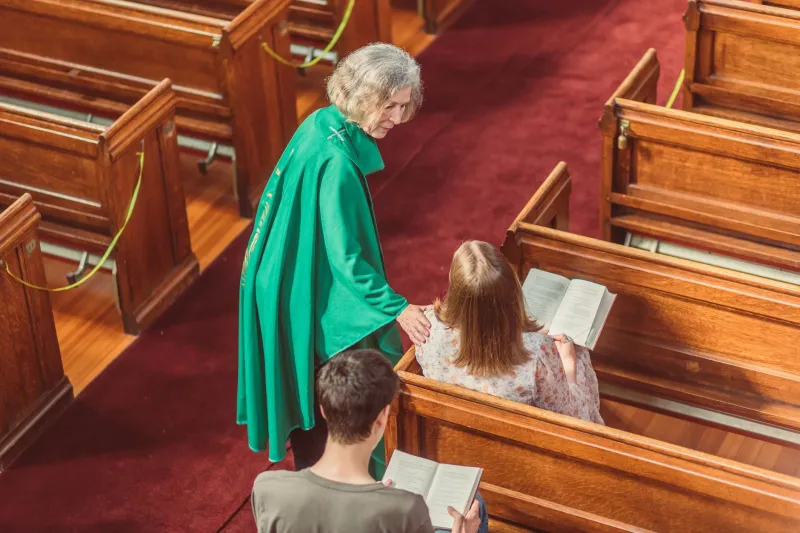
There is a particular kind of comfort that settles over Margaret Holloway when she walks through the doors of First UMC Geneva on a Sunday morning. It is not the comfort of familiar architecture, though the sanctuary is beautiful. It is not even the comfort of ritual, though the liturgy anchors her. It is something more intimate than either — the comfort of being recognized. Of being known.
"People here remember my mother," she says, pausing to find the right words. "They remember when my children were born. They were there when my husband died. There is no introduction required. You just walk in, and you are already part of the story."
Margaret has attended the same congregation for 41 years. In an era that rewards spiritual mobility — an era of church-hopping, online faith communities, and the well-documented rise of the religiously unaffiliated — her commitment reads almost countercultural. And yet, across Geneva, she is far from alone.
The Architecture of a Life Witnessed
Sociologists have spent considerable energy documenting the decline of institutional loyalty in American religious life. Fewer adults, particularly younger ones, feel bound to a single denomination or congregation. The reasons are complex: geographic mobility, theological disillusionment, the democratization of spiritual content through digital platforms. Church membership, for many, has become something one holds loosely.
But the long-term members of Geneva's faith communities offer a different testimony — one that speaks not to obligation or inertia, but to the profound relational architecture that only time can construct.
Robert Ames, a retired schoolteacher who joined First UMC Geneva in the late 1970s, frames it this way: "When you stay somewhere long enough, the congregation becomes a kind of living album of your life. They were at your wedding. They held your babies. They sat with you in hospital waiting rooms. And then, one day, you realize you've done the same for them. That's not a small thing. That's everything."
What Robert describes is, at its theological root, a form of covenant — the Methodist tradition's deep emphasis on communal accountability and mutual care expressed not in a single season but across an entire human life. It is the difference between a church that knows about you and a church that knows you.
The Seasons That Test and Deepen Roots
Long-term congregants are quick to acknowledge that their commitment has not been without friction. Congregations change. Pastors rotate. Worship styles evolve. Theological conversations that once felt settled are reopened. And sometimes, the community itself falls short of its highest calling.
Diane Kowalski, who has worshipped in Geneva for nearly three decades, admits there were years when she seriously considered leaving. "There was a period when the church was going through a difficult transition, and I felt unseen," she recalls. "I thought about finding somewhere that felt easier. But I stayed. And what I discovered on the other side of that difficulty was a much deeper understanding of what grace actually means — not just as a theological concept, but as something you practice with real people who disappoint you and whom you disappoint."
Her account points to something the self-help language of "finding your spiritual home" often obscures: that genuine belonging is not primarily about comfort. It is forged, in large part, through the willingness to remain present when presence is costly. The congregation that has seen you at your most vulnerable — grieving, failing, doubting — is also the congregation best equipped to celebrate your flourishing.
What Transient Faith Cannot Offer
This is not an argument against spiritual seeking, nor a dismissal of those whose circumstances — relocation, theological growth, or genuine harm — have led them from one community to another. The history of American Methodism is itself a story of movement and adaptation.
But the long-term members of Geneva's congregations name something with striking consistency: the experience of being witnessed across the full arc of a life is categorically different from the experience of entering a community mid-story.
"When you join a church at 45, they know the version of you that walks through the door," says Thomas Birch, who was baptized at First UMC Geneva as an infant and has remained ever since, now well into his sixties. "But the people who were there when I was confirmed, who watched me stumble through my twenties, who knew my parents before they passed — they carry a version of me I can't carry alone. That's a form of grace I don't think I could have found by starting over somewhere new."
There is also the matter of legacy — of what long-term members contribute to a congregation simply by remaining. Their institutional memory, their mentorship of younger families, their willingness to serve in unglamorous capacities year after year — these are the unseen load-bearing walls of any thriving faith community.
The Gift of Being Remembered
Perhaps the most quietly radical thing about lifelong congregational membership is what it says about the nature of identity itself. In a culture that increasingly invites individuals to reinvent themselves, to curate their own narrative, and to shed communities that no longer serve them, the long-term church member makes a different wager: that being held in memory by others is itself a form of grace.
At First UMC Geneva, this plays out in ways both grand and ordinary. It is the elder who remembers a young adult's confirmation verse and recites it back to them on a hard day. It is the deacon who has watched three generations of the same family receive communion at the same rail. It is the prayer chain that knows not just your name but your history — who your people are, what you have survived, what you are still hoping for.
"I used to think that loyalty to one church was a kind of limitation," Margaret Holloway reflects. "Now I think it's one of the most expansive decisions I ever made. Because of it, I have people in my life who know the whole of me. And in knowing me, they keep reminding me of who I am."
In a restless world, that is no small offering. It may, in fact, be one of the most profound gifts a community of faith can extend — the steadfast, unhurried, decades-long work of simply showing up for one another, season after season, until the whole of a life has been witnessed and held.
That is the church at its most faithful. And in Geneva, it is very much alive.