Seated Side by Side, Bound for Life: The Unlikely Power of the Pew Friendship
Nobody signs up for it. Nobody plans it. Yet some of the most enduring friendships in a person's life begin with nothing more than a shared hymnal and a weekly habit of showing up in the same wooden pew. At First UMC Geneva and congregations like it across the country, these accidental bonds are quietly defying every modern assumption about how meaningful relationships are made.
We live in an era that prizes intentionality. We curate our social lives through apps, algorithms, and carefully coordinated schedules. We build networks with purpose and prune them with precision. And yet, for all that deliberate engineering, many people find themselves profoundly lonely — surrounded by contacts but starved of companions. Against that backdrop, the humble pew friendship stands as something almost countercultural: a bond that asks nothing of you at the outset except that you keep showing up.
The Accidental Architecture of Belonging
There is something quietly remarkable about the social structure of a Sunday morning worship service. Unlike a dinner party, a neighborhood association meeting, or a workplace happy hour, the church sanctuary does not sort people by age, income, profession, or shared hobby. It gathers them by geography and by faith — two criteria broad enough to encompass nearly everyone, and specific enough to give them genuine common ground.
When two people happen to settle into adjacent seats on the same Sunday morning, they bring with them the full complexity of their separate lives. One may be a retired schoolteacher; the other, a thirty-something parent of three. One may have grown up in Geneva; the other may have arrived just last spring. On paper, they have little reason to become close. In practice, they are about to spend an hour in one of the most emotionally open environments modern life offers — singing together, praying together, sitting in silence together, and listening to words that touch the deepest questions any human being carries.
Proximity, repeated over weeks and months, does something that no networking event can replicate. It creates familiarity without agenda. You begin to notice things: that she always arrives five minutes early, that he hums slightly off-key during the opening hymn, that she mouths the words to the Lord's Prayer with particular intensity. Small details accumulate. A nod becomes a greeting. A greeting becomes a conversation in the narthex. A conversation becomes coffee. Coffee becomes a friendship that, years later, neither person can quite explain the origin of — except to say that it started in church.
What Shared Ritual Does That Small Talk Cannot
Social scientists have long understood that shared experience accelerates intimacy. What is less often acknowledged is that not all shared experiences are created equal. Watching a sporting event together, for instance, creates camaraderie — but it rarely opens the interior life. The church service, by contrast, is structured to do precisely that. Confession, lament, gratitude, hope — these are not abstract theological categories. They are the emotional vocabulary of a full human life, and the liturgy invites congregants to inhabit them together, week after week.
When you sit beside someone through the announcement of a church member's cancer diagnosis, through a sermon on grief and resurrection, through the passing of the peace on a Sunday when you yourself are barely holding together — you are not simply sharing space. You are sharing the texture of being alive. That shared texture becomes the substrate of a friendship that can hold real weight.
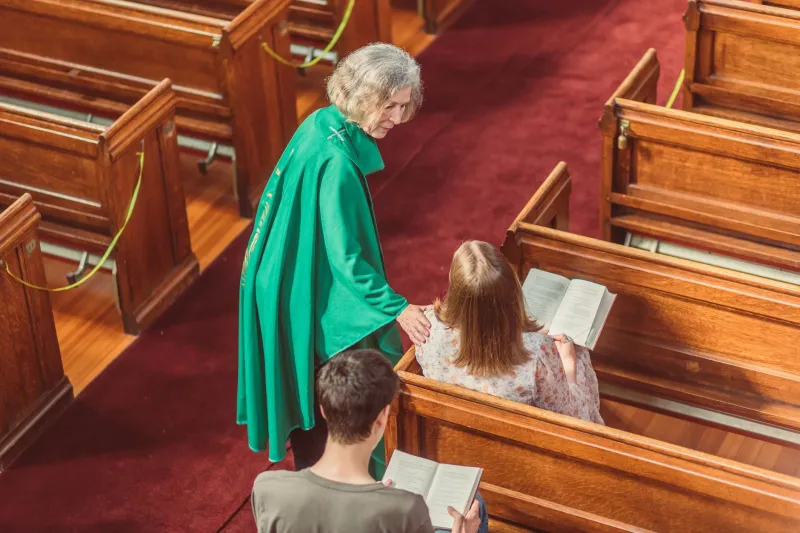
At First UMC Geneva, longtime members speak of pew neighbors who became the first phone call in a crisis — not because of any formal commitment, but because decades of side-by-side worship had created a trust that no single conversation could have manufactured. One member described learning of her husband's serious illness on a Thursday and finding herself, that Sunday, steadied simply by the presence of the woman who had sat to her left for eleven years. "She didn't say anything profound," the member recalled. "She just put her hand over mine during the prayer. That was enough. More than enough."
The Long Arc of the Accidental Bond
What distinguishes the pew friendship from many other forms of modern connection is its temporal depth. In a culture that moves quickly — that relocates for jobs, upgrades its social circles, and treats relationships as provisional — the congregation offers something rare: a community designed for permanence. People who meet in a church pew at thirty may still be sitting together at seventy. They witness one another's children grow up, attend one another's milestone celebrations, and eventually, if life follows its natural course, sit with one another in the shadow of loss.
This long arc matters enormously. Friendship researchers have noted that the bonds formed in young adulthood and sustained across decades carry a distinct psychological weight — they are the relationships that hold a person's full history, that remember who they were before life's complications accumulated. The church, almost uniquely among American institutions, creates the structural conditions for exactly this kind of longitudinal friendship. It asks people to keep returning to the same place, with the same people, across the full span of a life.
The result is a form of witness that goes beyond affection. A pew neighbor who has sat beside you through baptisms and funerals, through seasons of doubt and seasons of renewal, knows you in a way that few others do — not because you have shared every confidence, but because they have simply been present for the long, unedited version of your life.
What Modern Life Has Stopped Providing
It is worth pausing to name what is at stake here, because the conditions that make pew friendships possible are not guaranteed. The erosion of consistent Sunday attendance — accelerated by pandemic-era habits, the rise of online worship, and the general fragmentation of communal life — threatens the very repetition that these bonds depend upon. You cannot become someone's pew neighbor if you are rotating between three different services or watching a livestream from your couch.
This is not an argument against flexibility or accessibility in worship. It is, rather, an argument for showing up — for the irreplaceable value of physical presence in a shared space, week after week, among the same imperfect, beloved people. The digital world can extend community; it cannot originate the kind of trust that only accumulates through years of side-by-side presence.
First UMC Geneva has always understood its sanctuary not merely as a space for individual spiritual encounter, but as a place where the community itself is formed and re-formed, Sunday by Sunday. The friendships that grow from that formation are not incidental to the church's mission. They are, in many ways, the mission made visible — grace extended not through grand gestures, but through the quiet faithfulness of showing up beside someone, week after week, until the years have made you indispensable to one another.
A Friendship Worth Protecting
If you have a pew neighbor — someone whose face you have come to expect on Sunday mornings, whose absence you would notice, whose presence steadies you in ways you may never have articulated — consider that relationship a gift worth tending. Introduce yourself if you have not. Linger after the service. Accept the invitation to coffee. The friendship nobody planned may yet become the one that carries you.
And if you are new to Geneva, new to First UMC, or simply new to the practice of showing up consistently — find a seat and keep returning to it. You may not know yet who will end up beside you. But if history is any guide, that person may one day be among the most important in your life.