The Table That Keeps Showing Up: How Shared Meals After Worship Are Quietly Mending a Fractured World
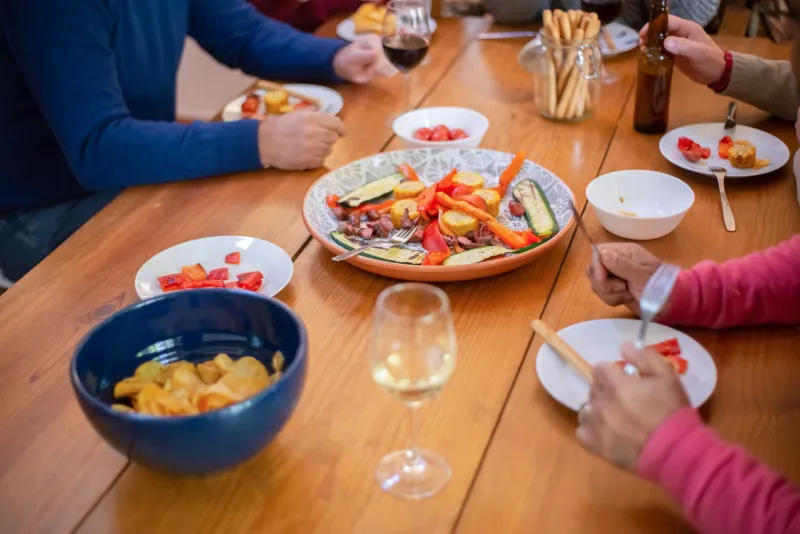
There is nothing particularly glamorous about a potluck dinner. The tablecloths rarely match. The macaroni salad from the third pew on the left has been arriving in the same ceramic bowl for eleven years. Someone always forgets napkins. And yet, for a growing number of members at First UMC Geneva, these Sunday gatherings in the fellowship hall have become something far more significant than the sum of their covered dishes — they have become the place where community, in the deepest and most theological sense of that word, is actually made.
 Photo: First UMC Geneva, via i.pinimg.com
This is not an accident. And in the context of what social scientists are calling a national loneliness epidemic, it may be one of the most quietly radical things a church in a midwestern town can do.
A Nation Sitting Alone
The numbers are difficult to ignore. According to a 2023 advisory from the U.S. Surgeon General, approximately half of American adults report measurable levels of loneliness — a figure that has been climbing steadily since long before the social disruptions of the pandemic accelerated the trend. The report described the crisis in stark terms, noting that the health consequences of chronic loneliness are comparable to smoking fifteen cigarettes a day. Dr. Vivek Murthy, who authored the advisory, used the phrase "social infrastructure" to describe the kinds of institutions, habits, and shared spaces that once buffered Americans against isolation. His conclusion was pointed: that infrastructure is eroding, and rebuilding it requires intentional effort.
 Photo: Dr. Vivek Murthy, via www.theliveschedule.com
Faith communities, the advisory noted, represent one of the most historically significant forms of social infrastructure in American life. Yet congregations across the country have watched their own membership patterns shift — attendance becoming more transactional, more episodic, and less rooted in the kind of sustained, reciprocal relationship that transforms acquaintances into genuine neighbors.
Which is precisely why what happens after the benediction at First UMC Geneva deserves a second look.
What Happens When People Linger
Ask Margaret, a retired schoolteacher who joined the congregation three years ago after relocating from out of state to be closer to her daughter's family, what the Sunday dinner table has meant to her. She will pause before answering — not because the question is difficult, but because the answer carries more weight than she expected.
"I came to this church knowing exactly no one," she says. "I sat in the service and I was moved, genuinely moved. But I also thought, 'I could disappear from this room and it wouldn't matter much.' And then someone handed me a plate and asked me to sit down, and two hours later I was still at the table talking to a man I'd never met about his grandchildren and his late wife and whether the Cubs would ever get it together." She laughs softly. "That was the moment this became my church."
Her experience is not unusual. Across the congregation, there is a pattern that pastoral staff and lay leaders have come to recognize: the formal worship service opens the door, but the informal meal is often where people decide to walk through it and stay.
For James and his husband, David, who relocated to the Geneva area two years ago and were cautiously searching for an affirming congregation, it was the fellowship table that signaled something deeper than tolerance. "Anyone can say the right words from a pulpit," James reflects. "But when you sit down with people and they ask you questions and they actually listen to the answers — that's when you understand what a congregation actually believes about who belongs."
The Theology of the Ordinary Table
There is, of course, a long and rich theological tradition behind the act of eating together. The Gospels are saturated with meals — the feeding of multitudes, the dinner at the home of Zacchaeus, the Last Supper, the breakfast on the shore after the resurrection. Jesus was, among other things, someone who kept showing up at tables and insisting that the wrong people be seated at them. The Methodist tradition, with its deep emphasis on practical holiness and the sanctification of everyday life, has always understood that grace does not confine itself to sanctuary walls.
The Rev. Dr. Sharon Caldwell, whose work on Wesleyan ecclesiology has explored the role of what John Wesley called "the means of grace," has written that communal meals function as what she terms "embodied hospitality" — a form of welcome that bypasses the cognitive filters people erect against belonging and speaks directly to something more instinctive and human. "You cannot be abstract at a dinner table," she has noted. "You are present, you are physical, you are sharing something you need to survive. That is a profoundly leveling and profoundly sacred thing."
At First UMC Geneva, that leveling quality is something congregation members describe again and again. The fellowship hall does not sort people by their professional status or their theological sophistication or the number of years they have occupied a particular pew. It sorts them only by hunger — and hunger, it turns out, is a remarkably democratic condition.
Small Acts, Significant Consequences
What strikes outside observers about these Sunday dinners is how deliberately unspectacular they remain. There is no formal programming attached to them, no curriculum or facilitator guiding the conversation toward prescribed outcomes. The tables are set, the food arrives, and people talk. That simplicity is, in the view of many longtime members, precisely the point.
"We live in a world that has turned everything into a product," observes Thomas, a retired engineer who has been a member of the congregation for over two decades. "Every experience is supposed to be optimized and branded and measured for impact. And then you sit down with a bowl of somebody's chili and a piece of cornbread and you just... talk. About nothing. About everything. That feels almost rebellious now."
The congregation's leadership has been thoughtful about preserving that quality even as the Sunday dinners have grown in both attendance and cultural significance within the life of the church. The emphasis remains on accessibility — there is no expectation that participants bring a dish, no sign-up sheet that might deter someone arriving for the first time, no cost attached. The table, in the most literal sense, is open.
An Invitation Worth Accepting
It would be too easy to conclude that the answer to a national crisis of disconnection is simply more potlucks. The loneliness epidemic is structural and systemic, rooted in forces — economic precarity, suburban sprawl, the architecture of digital life — that no casserole can fully address. Congregations like First UMC Geneva are not under the illusion that they are solving the problem alone.
But there is something clarifying about watching people choose, week after week, to stay at the table a little longer. In a culture that rewards efficiency and discourages the kind of unproductive, unhurried time that genuine friendship requires, that choice is not nothing. It is, in fact, an act of quiet resistance — a declaration that human beings are not best understood as isolated individuals optimizing their schedules, but as creatures made for one another, creatures who are most fully themselves when they are gathered around a common meal.
The table at First UMC Geneva keeps showing up. The tablecloths still don't match. The macaroni salad is still in the same ceramic bowl. And every Sunday, someone who arrived alone leaves knowing, at least a little more certainly, that they are not.