Before the First Hymn Is Sung: Why the Greeter at the Door May Be the Most Important Person in Your Church
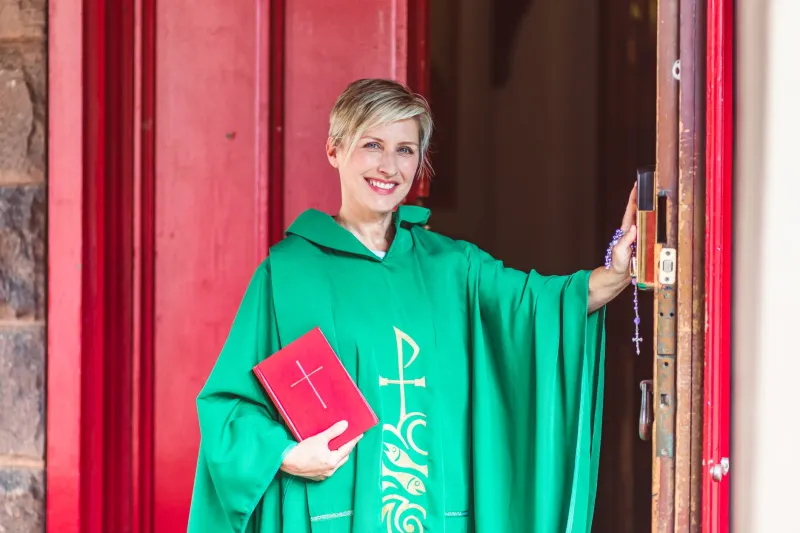
There is a moment — brief, unremarkable to most, yet quietly enormous — that happens every Sunday morning at the entrance of nearly every church in Geneva. Someone new arrives. They are nervous, perhaps, or quietly hopeful. They have driven past the building a dozen times. They have read the website, maybe even the bulletin posted online. And now they are standing at the threshold, waiting to learn whether this community will receive them.
What happens in the next sixty seconds can shape the rest of their spiritual life.
The Theology of the Open Door
Hospitality, in the Wesleyan tradition, is not merely a social grace. It is a theological act. John Wesley himself understood that the church's welcome was an extension of God's own prevenient grace — the love that reaches toward a person before they have done anything to earn it, before they have found the right words or the right faith or the right Sunday to show up.
At First UMC Geneva, that conviction has begun to reshape something as seemingly simple as who stands at the door on Sunday morning and what they are trained to do when they get there.
"We used to think of greeters as ushers with better people skills," says one longtime member who coordinates the welcome team. "Hand out a bulletin, point toward the restrooms, smile. But that's not what we're actually doing. We're offering someone their first experience of being known in this place. That matters enormously."
It does. Research on congregation growth and retention consistently identifies the quality of initial welcome — not the music, not the sermon, not the parking — as the single greatest predictor of whether a first-time visitor returns. And yet, for decades, many churches have treated the greeter role as the task you assign to whoever volunteers when no one else does.
A New Kind of Training
Several congregations in the Geneva area, led in part by the model developing at First UMC, have begun investing in what might be called a theology of presence at the door. Greeters are no longer simply handed a stack of bulletins and pointed toward the entrance. They participate in orientation sessions that explore the scriptural roots of welcome, the psychology of belonging, and the practical art of remembering a name.
That last skill turns out to be more consequential than it sounds. Neurologically, hearing our own name spoken by a relative stranger activates something deep in us — a recognition that we have been seen as an individual rather than an anonymous face in a crowd. For someone who has walked into a church alone, perhaps for the first time in years, that small act of being named can be the difference between feeling like a visitor and beginning to feel like a member.
Training sessions at First UMC now include exercises in name retention, guided conversation techniques, and — perhaps most significantly — a structured follow-up protocol. Greeters are encouraged to collect contact information from first-time visitors, not in a transactional way, but as part of an ongoing relationship. A text message sent on Tuesday. A handwritten note. A phone call on a Wednesday afternoon, not to recruit but simply to say: We noticed you were here. We're glad you came.
"That mid-week contact is where the real work happens," one greeter volunteer explains. "Sunday morning is the introduction. The follow-up is when you actually start becoming someone's church."
What Visitors Are Actually Experiencing
For those who have recently found their way to a Geneva congregation after years away from church — or after a move to a new city, or after a loss that sent them looking for something they couldn't quite name — the quality of that initial welcome is remembered with surprising clarity.
One woman who began attending First UMC Geneva after relocating from out of state describes her first Sunday as disorienting in the best possible way. "I expected to be invisible," she says. "I had been invisible in churches before. But the woman at the door — she asked my name, she asked where I'd come from, and she actually introduced me to two other people before the service started. I didn't feel like I was being processed. I felt like I was being welcomed into someone's home."
That domestic metaphor — the church as home rather than institution — runs through the hospitality theology that many progressive Methodist congregations are now actively cultivating. A home does not merely permit entry. It extends itself toward the arriving guest.
The Greeter as Spiritual Practitioner
What is perhaps most striking about the evolution of this ministry is how it has transformed the greeters themselves. Volunteers who initially signed up to fill a slot on a rotation describe finding unexpected depth in the role. Standing at the door with genuine intention, paying close attention to who arrives and how they carry themselves, holding space for someone's vulnerability without demanding anything in return — these are, it turns out, genuine spiritual disciplines.
"I came to this thinking I was doing the church a favor," admits one greeter who has served in the role for three years. "I didn't realize it would change how I pray, how I pay attention to people during the week. You start to see everyone as someone who is arriving somewhere for the first time."
That reorientation — toward attentiveness, toward the stranger, toward the unremarkable moment that might in fact be sacred — is precisely what First UMC Geneva hopes the wider community will absorb. Not just the greeters. Not just the welcome team. But the entire congregation.
Every Member a Greeter
The longer-term vision, articulated by pastoral leadership at First UMC, is a church culture in which the spirit of welcome is not confined to a volunteer station near the front entrance. It extends into the pews, into the coffee hour, into the parking lot, into the digital spaces where someone might encounter the church for the very first time.
The greeter at the door is, in this vision, not a specialist but a symbol — a visible expression of what the whole community is called to practice. And the Sunday morning text message, sent by a volunteer who took the time to write down a name and send a few words of genuine care into the week, becomes something larger than a follow-up protocol. It becomes an act of faith.
In a culture that has grown expert at making people feel unseen, the church that learns to truly see its visitors — before the first hymn, before the first prayer, before the doors have even opened wide — may be offering something more countercultural, and more urgently needed, than any sermon it will ever preach.