From Flannel Boards to Faith Foundations: How Geneva Churches Are Reinventing Children's Religious Education
From Flannel Boards to Faith Foundations: How Geneva Churches Are Reinventing Children's Religious Education
There is a particular kind of memory that many adults carry from their early years in a church basement — a folding chair, a construction-paper craft, a teacher reading from a worn Bible with genuine conviction. For decades, Sunday school was simply what you did if you went to church. Then, gradually, it wasn't.
Schedules filled. Youth sports expanded into Sunday mornings. Families grew more selective about how they spent their limited hours together. And Sunday school, with its reputation for rote memorization and outdated curriculum, began to feel like a relic rather than a resource.
But something is shifting in Geneva. Across the city's faith communities, including here at First United Methodist Church, parents are returning to children's religious education — not out of nostalgia, but out of genuine conviction that their children need something that a screen, a sport, or a classroom simply cannot provide.
What Changed — and What Didn't Work
To understand the revival, it helps to understand the decline. Sunday school, in its most traditional form, often prioritized content delivery over experience. Children memorized the books of the Bible, recited scripture passages, and completed worksheets — all valuable in their own right, but increasingly disconnected from the questions that children are actually asking today.
A generation raised on interactive media, social complexity, and open conversations about mental health doesn't respond well to passive instruction. They want to wrestle with ideas. They want to ask hard questions without being redirected. They want to feel that the stories they are hearing matter to their actual lives.
Many Geneva parents who stepped back from Sunday school did so not because they abandoned faith, but because the version of faith formation being offered felt insufficient. The question local congregations have been asking themselves is a demanding one: What would Sunday school look like if we designed it for the children who are actually sitting in our rooms?
Hands, Hearts, and Harder Questions
The answers emerging from Geneva's faith communities are varied, creative, and often surprisingly practical.
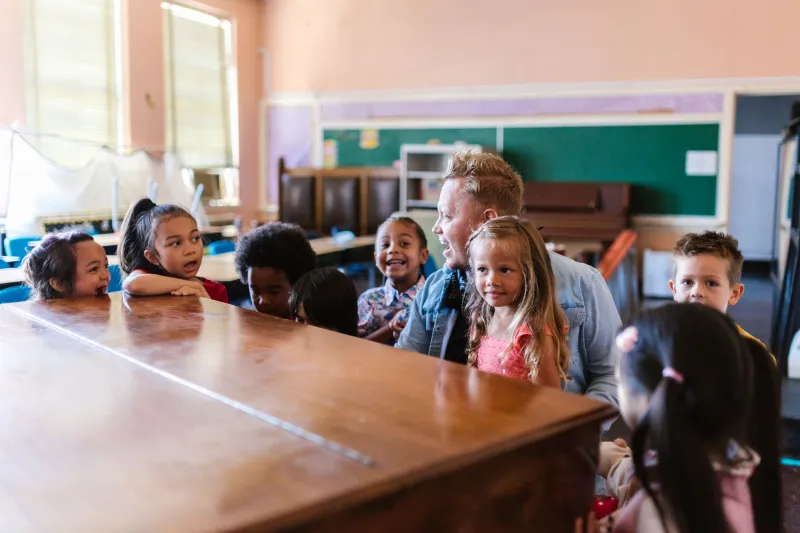
At First UMC Geneva, children's programming has moved steadily toward what educators call experiential learning — an approach that asks children to engage with faith through doing, not just hearing. Service projects woven into the Sunday morning hour. Storytelling that invites children to place themselves inside the narrative. Art, movement, and conversation that treat theological questions as worthy of genuine exploration rather than predetermined answers.
This shift reflects a broader understanding, increasingly supported by research in child development, that children form lasting values not primarily through information transfer, but through meaningful experience and trusted relationships. A child who helps pack food for a neighbor in need during Sunday school carries that lesson differently than one who reads about generosity in a workbook.
The harder questions are welcome, too. Geneva families report that their children are asking about suffering, about fairness, about what it means to believe something when so much in the world seems to contradict it. Progressive faith communities, in particular, have found that creating space for honest doubt — rather than suppressing it — actually deepens children's engagement with faith over time.
The Intergenerational Ingredient
One of the most significant changes in Geneva's reimagined Sunday school is the deliberate integration of older generations into children's learning.
There is something quietly powerful about a child sitting across from an elder of the congregation, hearing a story about how faith carried that person through a season of grief or uncertainty. It communicates something that no curriculum can fully replicate: that belief is not an abstract concept but a living inheritance, passed from person to person across time.
Several local congregations have introduced structured intergenerational programming — pairing children with adult mentors for shared projects, inviting older members to serve as storytellers, or organizing joint service opportunities that bring different age groups into genuine collaboration. Parents consistently name these moments as among the most formative their children experience.
The effect moves in both directions. Adults who participate in children's ministry frequently describe a renewed sense of purpose and a reconnection with the foundations of their own faith. Teaching a child, it turns out, has a way of clarifying what you actually believe.
Why Families Are Calling It the Most Important Hour
The parents returning to Sunday school in Geneva are not, by and large, doing so because they feel obligated. They are doing so because they have noticed something.
They have noticed that their children are navigating a world saturated with competing messages about worth, identity, and purpose — and that very few of those messages are grounded in anything that transcends the immediate. They have noticed that their children are hungry for community that isn't mediated by a device, for relationships that carry genuine weight, for a story about the world that is larger than what any algorithm can generate.
Sunday school, when it is done well, offers all of these things. It offers a child a community of peers who share a common language of faith. It offers trusted adults who are present not because they are paid to be, but because they believe the work matters. It offers a framework for understanding suffering, joy, justice, and grace that children can carry into every other hour of their week.
One Geneva mother, whose family returned to Sunday school participation after a several-year absence, described it this way: her daughter had begun asking questions at the dinner table — about kindness, about what it means to be fair, about why some people have so much and others so little. Those conversations, she said, were not coming from school. They were coming from Sunday morning.
An Invitation Worth Accepting
The revival of children's religious education in Geneva is not a return to the past. It is something more interesting than that — a genuine reinvention, shaped by what we now understand about how children learn and what they need, and grounded in a conviction that faith formation is not a supplement to childhood but one of its most essential dimensions.
For families who have drifted away from Sunday school, or who have never quite found their way into it, the invitation stands. The rooms have changed. The conversations have deepened. The welcome, as it has always been at First UMC Geneva, is genuine.
The most important hour of your child's week may be the one that begins when the rest of the building settles into worship — and a teacher opens a door, pulls up a chair, and asks a question worth spending a lifetime answering.