Raising Spiritually Literate Children: Why Geneva Families Are Turning Back to Faith Formation
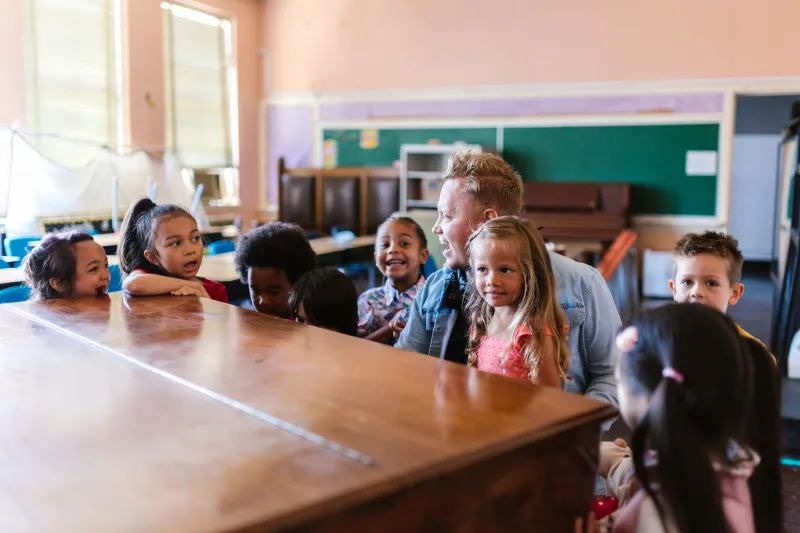
On a recent Sunday morning at First United Methodist Church of Geneva, a room full of third-graders sat in a loose circle on brightly colored floor cushions, wrestling with a deceptively simple question: What does it mean to be a good neighbor? Their teacher — a retired schoolteacher who has led children's programming here for over a decade — waited patiently as hands shot up, each answer more earnest than the last. The scene was, in one sense, entirely ordinary. In another, it was a quiet signal of something significant happening across Geneva's faith communities.
Sunday school is coming back.
Not in the rote, memorization-heavy form many parents remember from their own childhoods — the recitation of Scripture verses, the felt-board Bible stories, the gold stars awarded for attendance. What is returning is something more intentional, more emotionally sophisticated, and frankly more urgent. Across multiple congregations in the Geneva area, enrollment in children's and youth faith formation programs has climbed steadily over the past several years, reversing a decline that once seemed irreversible.
The parents behind this shift are not, for the most part, the deeply churched faithful who never left. Many of them drifted away from organized religion in their twenties, returned when children arrived, and are now making a conscious, even countercultural, choice to invest in their children's spiritual development.
What Changed — and Why Now
It would be too simple to attribute this resurgence to a single cause. But speak with enough Geneva parents and a consistent set of anxieties emerges. Screen time. Social media. The erosion of shared moral vocabulary. The sense that children are absorbing values constantly — from YouTube channels, from peer groups, from the ambient noise of a fragmented digital culture — but that those values are rarely examined, rarely named, and almost never placed within any larger framework of meaning.
"I realized my daughter could tell me the plot of every episode of three different shows, but she had no language for why honesty matters, or what she owes to the people around her," said one Geneva mother, whose family re-enrolled their two children in Sunday school two years ago. "That felt like a gap I didn't know how to fill on my own."
This is the emotional core of what is driving families back through the church doors: not primarily theological conviction, though that is present for many, but a hunger for structured moral formation in a world that seems to offer precious little of it. Parents are looking for a community that will reinforce the values they are trying to instill at home — and doing so within a tradition that carries weight, story, and history.
A Curriculum Built for This Moment
Church educators across Geneva have not been passive in the face of this opportunity. The Sunday school of 2025 looks substantially different from its predecessors, and the redesign has been deliberate.
At First UMC Geneva, the children's faith formation curriculum has been overhauled to center on what educators call "whole-child engagement" — an approach that weaves together Biblical narrative, ethical reasoning, creative expression, and community service into a single, coherent experience. Children are not simply taught about faith; they are invited to practice it in age-appropriate ways, from writing letters to homebound congregation members to participating in the church's food pantry drives.
"We want children to understand that faith is not a subject you study and then put away," explained the church's Director of Christian Education. "It is something you live. Our job is to give them the vocabulary and the experiences to begin doing that."
The curriculum also takes seriously the world children actually inhabit. Lessons address digital ethics, the complexity of friendship, questions of fairness and justice — themes that resonate with what children encounter daily. Rather than treating the secular world as something to be insulated against, educators are teaching children to bring their faith into that world as a lens for discernment.
The Role of Community in Spiritual Growth
Perhaps the most underappreciated dimension of this resurgence is what it offers children beyond the classroom itself. Faith formation, at its best, is not merely instructional — it is relational. Children who participate in Sunday school are not just learning; they are becoming part of a community that will know them across time.
For many Geneva families, this longitudinal dimension is among the most compelling aspects of church involvement. In an era when children's social lives are often mediated through screens and organized around achievement, the Sunday school classroom offers something rarer: a space where children are valued simply for who they are, where adults outside the immediate family invest in their growth, and where friendships form across the natural silos of grade and school.
"My son's Sunday school teacher remembered his birthday. She asked about his soccer game. She noticed when he seemed off one week and pulled me aside afterward," said one Geneva father. "That kind of sustained attention from a trusted adult — that is not something you can manufacture."
This web of caring relationships, researchers increasingly note, is one of the most protective factors in adolescent development. The church, at its most functional, provides exactly this kind of social architecture — and parents are beginning to recognize it.
Meeting Families Where They Are
Churches in Geneva have also become more pragmatic about the barriers that once kept families away. Rigid attendance expectations have given way to more flexible models. Some congregations offer mid-week faith formation options for families whose Sundays are consumed by youth sports and other activities. Digital resources allow children to engage with lesson content throughout the week. And there is a growing recognition that welcoming a family means welcoming the full complexity of their schedule, their doubts, and their questions.
First UMC Geneva has made particular efforts to be transparent about what it teaches and why, offering parent orientations at the start of each program year and creating channels for ongoing conversation between educators and families. The goal, as one staff member put it, is to make faith formation a partnership rather than a handoff.
The Deeper Invitation
What this quiet resurgence ultimately reflects is something more profound than a trend in children's programming. It is a reckoning, on the part of many Geneva parents, with the limits of a purely secular approach to raising children. It is an acknowledgment that children need not just information, but formation — not just knowledge of the world, but wisdom about how to live in it.
The church has always understood this. What is new is the number of families willing to say so out loud, and to act on it.
The third-graders in that Sunday morning circle eventually settled on an answer to their teacher's question. A good neighbor, they decided, is someone who shows up — even when it is inconvenient. Even when you are not sure what to say. Even when you are still figuring things out yourself.
It is hard to imagine a more fitting description of what Geneva's faith communities are doing right now.